Why the indoor coil is a common odor source
The evaporator coil sits above or beside the furnace in most east Denver basements. During cooling it is cold and wet, and dust that slips past the filter sticks to it. Combined with warmth when the system cycles off, that wet, dusty surface is a good place for microbial growth. People often describe the result as a dirty-sock or locker-room smell.
Below the coil is a drain pan, and from the pan a condensate line runs to a floor drain, a condensate pump or the sump. If that line clogs with slime, water sits in the pan. If the line drains into a floor drain without an air gap, sewer gas can be drawn back up the line into the air handler. A condensate pump with a dirty reservoir can smell as well.
Denver summers are short and dry compared to many places, so systems often sit idle for most of the year. That means a coil and pan that were fine last fall can start smelling in the first warm weeks of June, when the system starts cycling again.
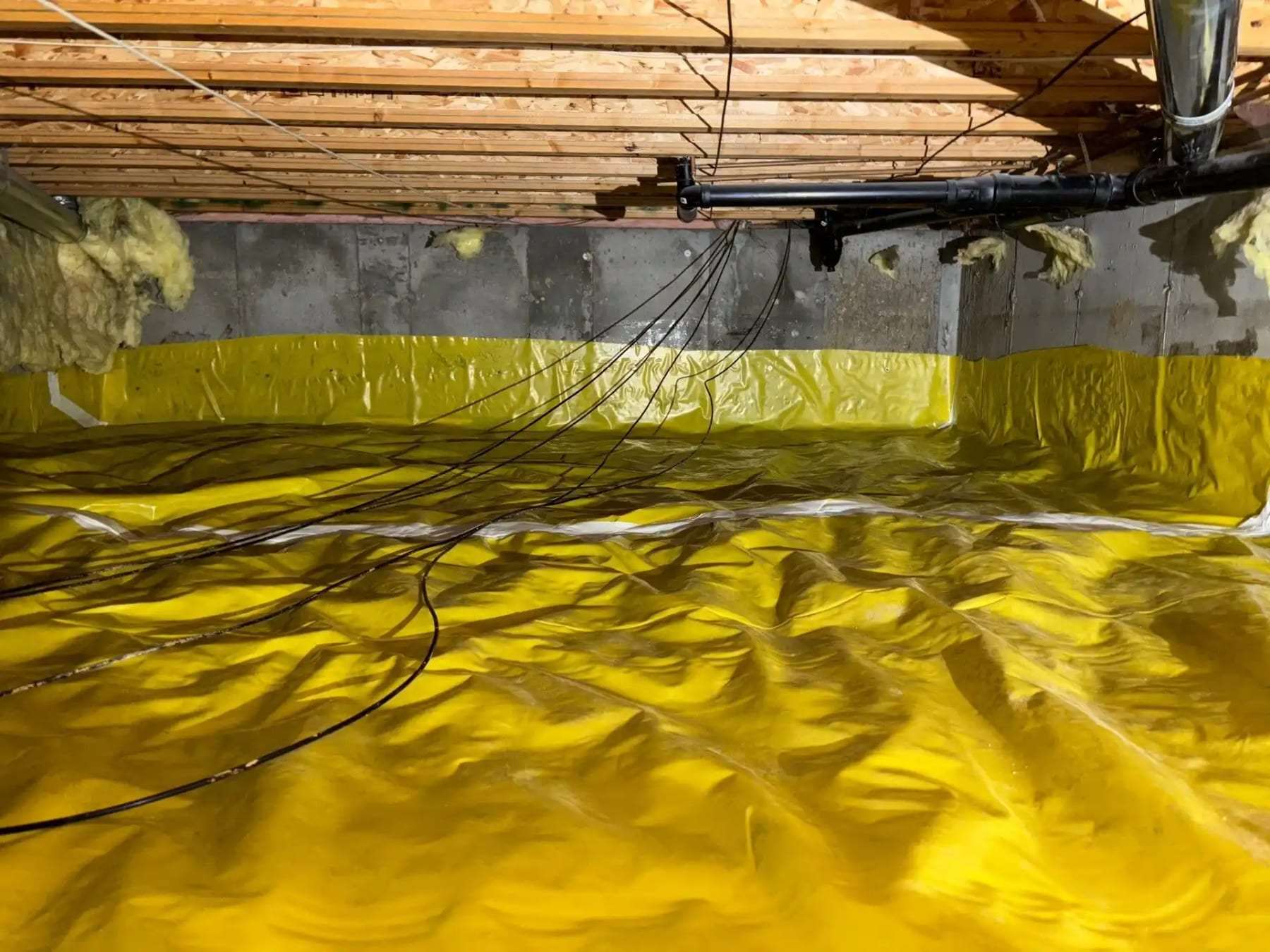
Crawlspace floor and walls sealed with a yellow vapor barrier. A representative photo of the task, not a record of work at any particular property.
When AC odor tends to show up during the year
A typical pattern for central air in a Front Range basement.
- Late spring startup
- First cooling cycles release a stale smell that built up while the coil sat dusty and dry over winter.
- Early summer
- Coil runs wet daily. Clogged condensate lines often overflow or back up in this stretch.
- Mid to late summer thunderstorm season
- Outdoor humidity spikes. Coils run wetter, pans fill faster, and musty odor is often strongest.
- First cool weeks of fall
- System switches to heat. Any residue left on a damp coil can give off a brief burnt-dust or musty smell.
- Winter
- Coil is dry and idle. Odor that persists now likely comes from somewhere other than the AC.
Simple checks before calling for service
Turn the system off at the thermostat and at the service switch before opening anything.
Change the filter
Replace it with the correct size and confirm the filter slot is covered so air can't bypass it.
Find the condensate line
Trace it from the coil to where it ends. Check for standing water, slime or a disconnected section.
Check the pump if there is one
Look into the condensate pump reservoir. A slimy, smelly reservoir should be cleaned following the maker's guidance.
Look for an air gap
If the line runs into a floor drain, it should end above the drain opening, not sealed into it. Ask an HVAC technician if you're unsure.
Sniff at a supply register
Run cooling for ten minutes and compare the smell at a register with the smell in the basement. Stronger at the register points to the air handler.
What to ask the HVAC technician
- Can you show me the condition of the coil and the drain pan, with photos if they're hard to see?
- Is the condensate line properly trapped and draining with an air gap?
- Is there any sign of water leaking into the furnace cabinet or onto the floor?
- Are there return leaks pulling basement or crawl space air into the system?
- Is the system sized so it runs long enough to remove moisture, or does it short-cycle?
- Would coil cleaning help, and what cleaner do you use around the coil?
General information for Hilltop, not a quote or professional advice. In an emergency, call 911.