Before the visit
- Which line will be inspected, and from what access point?
- Will the footage be recorded, and will I receive a copy?
- Will the inspection include the line under the slab, or only the exterior portion?
- What defects will be marked, and how will their location be documented?
- What will the report say about the condition of the pipe material?
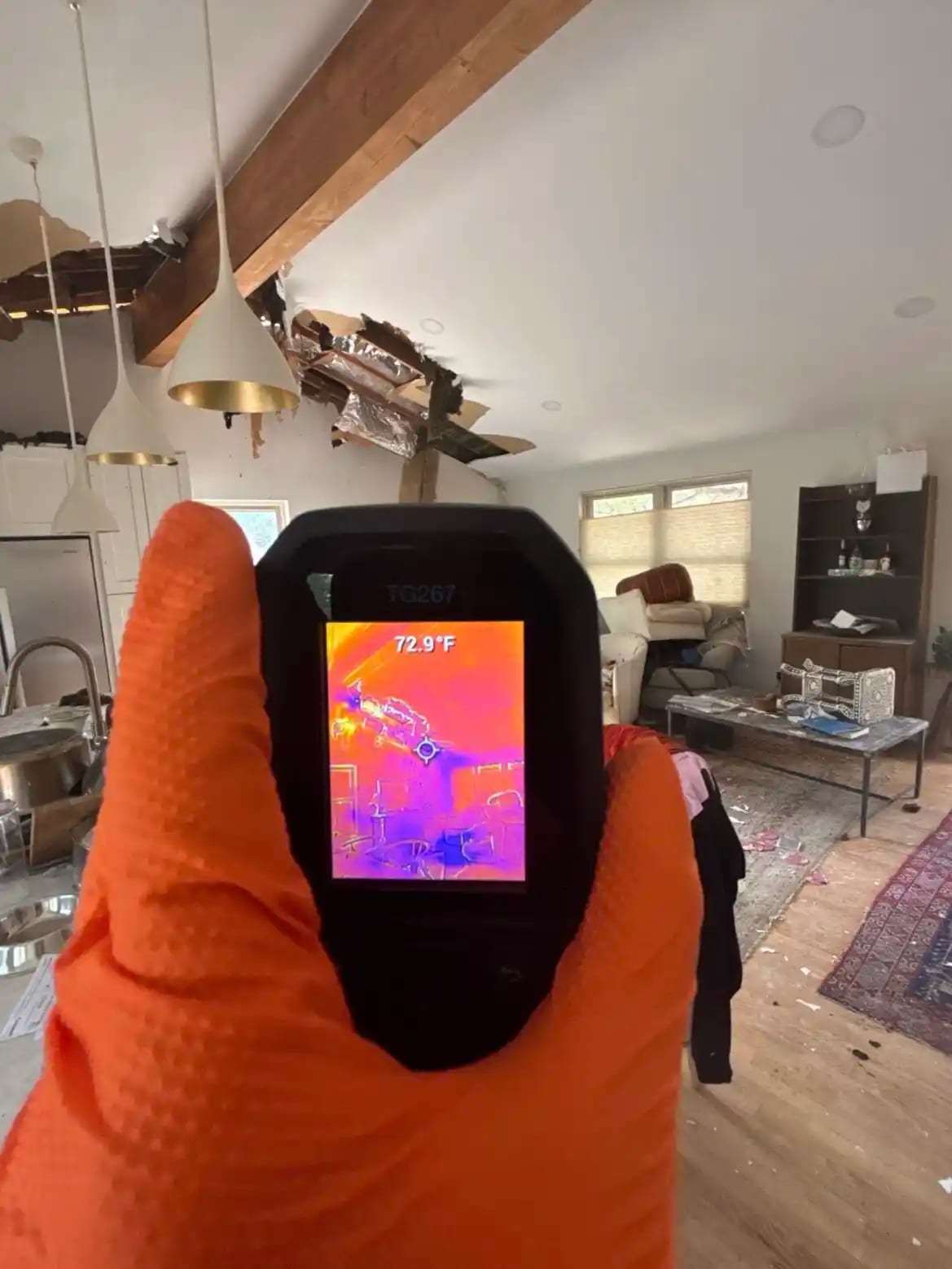
Thermal imaging camera held up toward a living room ceiling. A representative photo of the task, not a record of work at any particular property.
After the visit
Review the footage with the technician if you can.
- Where exactly are the defects, and how far from the access point?
- Which findings are likely to allow gas or water to escape?
- Which findings are normal wear and which are urgent?
- What repair options exist, and what does each involve?
- Should the line be re-inspected after any repair?
Terms in a report
- Offset
- A joint where two pipe sections have shifted out of line.
- Belly
- A low spot where water collects in a pipe.
- Root intrusion
- Roots that have entered through a joint or crack.
- Scale
- Buildup on the inside of older pipe that can narrow the passage.
- Lining
- A repair that places a new inner surface inside an existing pipe.
Connecting the footage to the smell
Not every defect produces a smell, and not every smell comes from a defect. A cracked pipe under a slab can leak gas upward, while a belly mostly holds water and debris. A good inspection links what is seen to what you smell, and says what has not been ruled out.
Keep the footage and report with your house records. If a repair is recommended, ask for it in writing and consider a second opinion for major work. Re-check the smell afterward to see whether the finding explained it.
If the camera finds nothing, that is useful too. It points the search back to traps, vents, pits and moisture, and it may spare you from invasive work.
Ask whether the technician can mark the surface above any defect so the repair can be located later.
Find out how the camera was cleared of debris and whether the line was cleaned first, since that affects what can be seen.
Ask whether the findings relate to the smell you described, and ask the technician to say plainly where the evidence stops.
Common questions
Does a camera inspection find every smell source?
No. It shows what is inside the pipe. Smell can also come from traps, vents and moisture.
How long does an inspection take?
It varies by access and line length, so ask when you book.
General information for Hilltop, not a quote or professional advice. In an emergency, call 911.