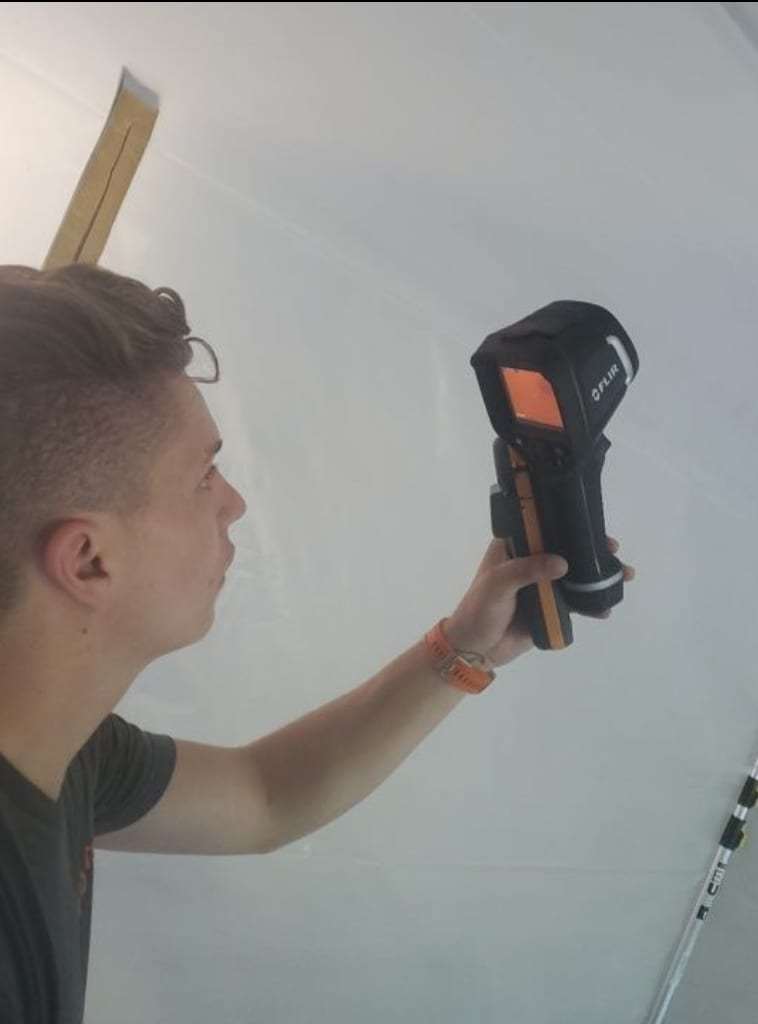
Technician scanning a plastic-covered wall with a thermal camera. Shown to illustrate the work described; not a job for this site or at any address named here.
Moisture sources and signs
| Source | Signs | First check |
|---|---|---|
| Exterior drainage | Damp after rain, staining at the lower wall | Gutters, downspouts, grading |
| Foundation cracks | Weeping lines, mineral deposits | Position and pattern of cracks |
| Plumbing leaks | Staining near pipes, constant dampness | Meter test and visual check |
| Condensation | Water on cold pipes and surfaces in warm months | Humidity readings |
| Humid indoor air | High readings throughout | Dryer vent, laundry, ventilation |
| Window wells | Water at the sill after storms | Drains and covers |
Plan the order of fixes
Start with the cause that feeds all others.
Stop outside water
Fix gutters, extensions and grading before interior work.
Fix leaks
Repair plumbing and any active seepage.
Control humidity
Add ventilation or dehumidification where needed.
Dry materials
Let materials dry or remove those that cannot recover.
Clean and finish
Clean surfaces and only then consider sealing or odor treatment.
Using the map
Draw the basement as a rectangle and mark each wall, window, drain, pit, pipe and appliance. Add the smell notes and readings from your diary. Circle spots where several signs overlap, such as a stained corner near a downspout with high readings after rain.
The overlap points tell you where to look first. If two sources overlap in one spot, such as a window well and a crack, fix the outside cause and retest. Mark the map again after each fix so you can see what changed.
If you hire help, the map and notes show them exactly where you suspect trouble and what you have already tried.
A map also protects you from chasing the loudest symptom. A stained carpet corner draws attention, but the water may enter at a window well several feet away and travel along the slab. Marking both on one sketch shows the distance between symptom and source.
Keep the map with your other records. Next season, comparing a fresh sketch with this one shows whether the pattern changed after drainage work, a new appliance or a rebuilt landscape bed.
Treat the finished map as a working document. Add dates beside each mark so you can see how long a condition has lasted, and cross out sources once a fix has been checked through at least one wet period.
Common questions
Do I need to fix everything on the map?
No. Start with the most likely source and retest. Often a single fix removes the pattern.
How detailed should the sketch be?
Rough is fine. Walls, openings, drains and the places where you smell or measure something are enough.
How long should I watch after a fix?
Watch through at least one storm or humid spell, since a fix that looks good on a dry day may not hold under load.
General information for Hilltop, not a quote or professional advice. In an emergency, call 911.